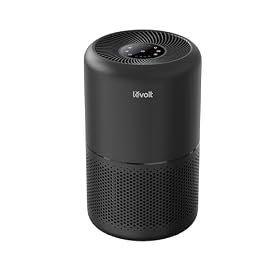
AHAM-verified CADR gives you a standardized, independently checked way to compare air purifiers. An uncertified claim is not automatically false, but you should check what was measured and under what conditions.
What AHAM-verified CADR means
CADR, or Clean Air Delivery Rate, estimates how quickly an air purifier delivers filtered air. It is reported in cubic feet per minute (CFM) and is measured for three particle categories: tobacco smoke, dust, and pollen. A higher CADR means faster particle removal under the test conditions; it does not mean the purifier captures that percentage of every pollutant.
AHAM Verifide is a voluntary certification program for home appliances. For air purifiers, it uses standardized CADR testing under the applicable AHAM method, with results verified through the program. It is not a government approval or a guarantee that a purifier is quiet, inexpensive to maintain, or effective against every type of pollution.
Product prices and availability are accurate as of the date/time indicated and are subject to change. Any price and availability information displayed on Amazon.com at the time of purchase will apply to the purchase of this product.
How to check a CADR claim
Look up the exact purifier model in AHAM’s current Verifide directory. Match the full model number, since similar product names or variants can have different ratings. Compare the listed smoke, dust, and pollen CADR values with the numbers in the product listing or manual.
If a model is not listed, that does not prove its CADR claim is wrong. It means the claim is not verified through AHAM Verifide. The manufacturer may have used another test method, or may be publishing its own results. Look for the test standard, the testing organization, and separate CADR values for smoke, dust, and pollen. A single unlabeled “CADR” number is harder to evaluate.
Compare like with like
When comparing two purifiers, check that the figures refer to the same pollutant and testing method. Also check which fan speed produced the rating. CADR is commonly most useful as a measure of performance at the tested setting, while everyday use may be at a quieter, lower setting.
Be cautious about treating airflow, filter efficiency, or a marketing “coverage area” as CADR. Airflow alone does not account for how well the unit removes particles, and a filter’s capture percentage is not the same as the purifier’s room-level clean-air delivery.
CADR is primarily a particle-cleaning measure. It does not tell you how well a purifier removes odors or gases; for those, consider the type and amount of activated carbon or other gas-filtering media, as well as the manufacturer’s test evidence.
Use CADR to judge room fit
AHAM’s room-size guidance is based on smoke CADR and a standard ceiling height. As a quick screening rule for a typical room, look for a smoke CADR of roughly two-thirds of the room’s floor area in square feet. For example, a 300-square-foot room calls for about 200 CFM of smoke CADR or more under that rule.
This is a starting point, not a guarantee of a particular result. Higher ceilings increase the air volume, and open layouts, frequent door openings, or stronger particle sources can call for more cleaning capacity. If the room is larger or you want more frequent air cleaning, choose a higher CADR or consider using more than one purifier. Check the manufacturer’s room-size assumptions and remember that the highest CADR setting may be noisier.
Bottom line
AHAM-verified CADR is a useful apples-to-apples reference because the rating is tied to a standardized test and verified through a recognized voluntary program. An uncertified number can still be meaningful, but it deserves more checking: confirm the test method, pollutant, model, and fan setting before relying on it. For room sizing, use smoke CADR as a practical guide and account for ceiling height, noise, and how intensively you need to clean the air.
FAQ
Does AHAM certification mean an air purifier is the best choice?
No. AHAM Verifide provides standardized, verified CADR information, which helps compare particle-cleaning performance. It does not by itself assess noise, filter replacement costs, gas removal, or every other feature that may matter to you.
Is an air purifier with no AHAM listing unsafe or ineffective?
Not necessarily. AHAM Verifide is voluntary. A purifier without a listing may have been tested another way or may publish manufacturer-reported results. Check for a clear test method and separate CADR figures before comparing its claims.
Which CADR number should I use for room sizing?
Use the smoke CADR as a practical starting point for particle cleaning. AHAM’s general room-size guidance relates smoke CADR to floor area under standard assumptions; adjust for higher ceilings and your desired cleaning intensity.
Does CADR measure odor removal?
No. CADR ratings cover smoke, dust, and pollen particles. They do not establish how well a purifier removes odors or gases. For those concerns, look for appropriate gas-filtering media and relevant test evidence.