Air Purifiers

Use Cases · Mon Sep 21

Child-lock air purifier for a toddler room

A child lock can prevent accidental changes to an air purifier’s settings, but it does not make the unit childproof. Prioritize a stable design, suitable room coverage, quiet operation, and a lock that works as you expect.

Child-lock air purifier for a toddler room

A child-lock air purifier can keep little hands from changing its settings, but the lock is only one part of a safe setup. Look for a purifier with a clearly documented control lock, enough capacity for the room, a quiet low setting, and a stable shape you can place out of your toddler’s reach.

What to look for

Check what the child lock actually does

Manufacturers use “child lock” for different functions. It may disable most buttons, all controls, or only certain settings. Check the manual to see whether the lock prevents the unit from being turned off, how to activate it, and whether it stays enabled after unplugging or a power outage. If the lock resets, you may need to turn it on again after a power interruption.

A control lock is not a physical barrier. Keep the purifier where your child cannot climb on it, pull it over, or reach its cord. Choose a stable, level placement and follow the manufacturer’s clearance and placement instructions.

Match coverage to the room

Use the purifier’s stated room-size guidance or clean air delivery rate (CADR) to judge whether it can clean the toddler’s room adequately. CADR indicates how quickly a purifier delivers filtered air; a higher rate generally supports a larger room or more frequent air cleaning. Compare ratings using the same room-size or air-change assumptions, when provided.

If the bedroom is larger than the manufacturer’s recommended area, the purifier may not clean the whole room as effectively as expected. Measure the room and check the product’s coverage details rather than relying on terms such as “large room” alone.

Favor practical filtration and quiet operation

For particles such as dust and pollen, look for a unit with a well-documented mechanical particle filter, such as a HEPA filter. A carbon filter may help reduce some odors, but performance depends on the amount and type of carbon and the pollutant; it is not a substitute for removing the source of an odor.

Check the sound level on the setting you expect to use overnight. A purifier may be quiet on its lowest setting but provide less airflow there. Consider whether that setting still provides suitable coverage for the room. Also check whether the display can be dimmed or turned off if lights could disturb sleep.

Avoid units that intentionally produce ozone. If a purifier includes ionizing or other optional air-treatment features, check the manufacturer’s documentation and choose a model whose particle filtration can operate without a feature you do not want.

Set it up safely in a toddler’s room

  • Place the purifier on a firm, level surface where a child cannot pull it down or climb on it.
  • Keep cords out of reach and away from walkways. Do not use a damaged cord or an outlet that feels loose.
  • Follow the manual’s spacing requirements; do not block the air intake or outlet with furniture, curtains, bedding, or toys.
  • Activate the control lock and confirm which buttons it disables before leaving the unit running.
  • Keep the purifier away from water and follow the manufacturer’s instructions for cleaning and filter changes. Unplug it before servicing unless the manual says otherwise.

An air purifier does not replace adult supervision, safe ventilation, or fixing the source of smoke, dust, or odors. Keep working smoke alarms in the home and follow their instructions.

Air purifier with a child lock for a toddler bedroom

Product prices and availability are accurate as of the date/time indicated and are subject to change. Any price and availability information displayed on Amazon.com at the time of purchase will apply to the purchase of this product.

Make the purchase decision

A good fit is a purifier whose child lock behaves as needed, whose coverage suits the measured bedroom, and whose regular operating setting is quiet enough for sleep. Before buying, check the ongoing filter cost and how often the manufacturer recommends replacement. Confirm that replacement filters are available for the exact model; filter shapes and fit are not necessarily interchangeable across units.

If a product’s lock behavior or room-coverage claim is unclear, consult its manual or manufacturer before choosing it. Do not rely on a child lock to make an otherwise unstable or reachable appliance safe.

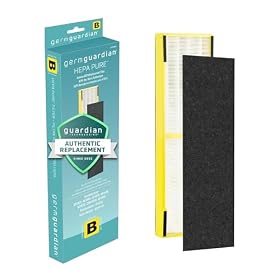
Replacement filter for a selected purifier

Product prices and availability are accurate as of the date/time indicated and are subject to change. Any price and availability information displayed on Amazon.com at the time of purchase will apply to the purchase of this product.

FAQ

Does a child lock stop a toddler from turning an air purifier off?

It depends on the model. Some locks disable the power button; others disable only selected controls. Check the manual for exactly what is locked and whether the setting persists after a power interruption.

Where should I put an air purifier in a toddler’s room?

Use a firm, level location that follows the manufacturer’s clearance instructions and keeps the unit, cord, intake, and outlet away from the child, bedding, curtains, and toys.

Is a HEPA air purifier safe to run overnight in a child’s room?

Many are designed for continuous operation, but follow the manufacturer’s instructions. Choose a setting with suitable room coverage and acceptable noise, and avoid units that intentionally produce ozone.