What Size Air Purifier for a Bedroom? A Simple Sizing Guide
Match an air purifier’s smoke CADR to your bedroom’s area and ceiling height. A little extra capacity can help you run it at a quieter speed.
For most bedrooms, choose an air purifier with a smoke CADR suited to the room’s floor area and ceiling height. As a quick starting point for an 8-foot ceiling, look for a smoke CADR of about two-thirds of the room’s area in square feet. For example, a 12-by-14-foot bedroom is 168 square feet, so a CADR around 112 cubic feet per minute is a reasonable target. This rule of thumb corresponds to roughly five air changes per hour; it is a sizing guide, not a guarantee of performance in every room.
Calculate the right size for your bedroom {#calculate-bedroom-size}
Measure the room’s length and width, then multiply them to get its floor area. Check the purifier’s published smoke CADR—the clean-air delivery rate for smaller particles—rather than relying only on a manufacturer’s suggested room size.
For a more precise estimate, use the room volume and a target air-change rate:
CADR (cfm) = room volume (cubic feet) × target air changes per hour ÷ 60
For a 12-by-14-foot room with an 8-foot ceiling, the volume is 1,344 cubic feet. A target of four air changes per hour requires about 90 cfm; five requires about 112 cfm.
The two-thirds-of-floor-area rule assumes an 8-foot ceiling and is a convenient shortcut for roughly five air changes per hour. If your ceiling is higher, adjust the target upward in proportion to the ceiling height. For instance, a 10-foot ceiling has 25% more air volume than an 8-foot ceiling, so you would need about 25% more CADR to maintain the same air-change rate.
Choose for how you’ll actually run it {#choose-usable-cadr}
A purifier’s CADR is typically tied to its fan speed. If the only way to reach the stated performance is to run it louder than you can tolerate while sleeping, you may end up using a lower speed and getting less air cleaned.
Consider a unit with more capacity than the minimum if you want to run it on a quieter setting. Check whether the manufacturer publishes CADR at different speeds; if it gives only a maximum CADR, that figure may not describe performance on a quiet or sleep mode. Compare noise information for the speed you expect to use, not just the lowest advertised setting.
Keep the purifier’s air intake and outlet clear, and follow the placement instructions. A purifier cannot clean the whole bedroom effectively if its airflow is blocked or it is tucked into a tight corner.
Product prices and availability are accurate as of the date/time indicated and are subject to change. Any price and availability information displayed on Amazon.com at the time of purchase will apply to the purchase of this product.
Adjust for smoke, allergies, and room conditions {#adjust-for-room-conditions}
If you are sizing for wildfire smoke or another fine-particle problem, prioritize smoke CADR and consider extra capacity so the unit can run at a speed you find acceptable. For pollen, dust, or pet dander, a particle filter such as a true HEPA filter may be useful, but the unit still needs enough airflow for the room.
Room-size ratings are often based on assumptions about ceiling height and air changes. Compare those assumptions with your room rather than treating the printed square-foot figure as an exact limit. Open doors, connected spaces, frequent air leaks, and strong particle sources can also affect results.
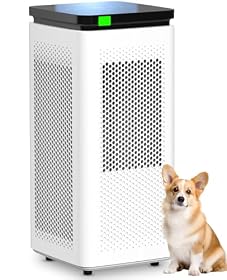
Higher-capacity purifier for a large or high-ceiling bedroom
Product prices and availability are accurate as of the date/time indicated and are subject to change. Any price and availability information displayed on Amazon.com at the time of purchase will apply to the purchase of this product.
Compare the smoke CADR with the room’s area or calculate a target from room volume.
Choose enough capacity to run the purifier at a tolerable setting, especially overnight.
Check filter type, replacement-filter availability, and the manufacturer’s maintenance instructions.
Place the unit where air can circulate around its intake and outlet.
If the bedroom is unusually large or has a high ceiling, size by room volume rather than relying on a basic square-foot label. When in doubt, follow the manufacturer’s room-size and operating guidance.
FAQ
What CADR do I need for a 200-square-foot bedroom?
With an 8-foot ceiling, the two-thirds rule of thumb points to a smoke CADR of about 133 cfm. A volume calculation gives about 107 cfm for four air changes per hour or 133 cfm for five.
Is it okay to get an air purifier that is larger than my bedroom needs?
Yes. More capacity can let you use a lower, quieter fan speed while still moving a useful amount of air. Check the unit’s CADR at the speed you plan to use.
Should I use the air purifier’s maximum speed while sleeping?
Not necessarily. Use a setting you can tolerate and that provides enough airflow for your room. If a quiet setting does not publish a CADR, its cleaning performance may be lower than the maximum rating.
Does ceiling height change the size of air purifier I need?
Yes. A higher ceiling means more air volume in the room. Increase the required CADR in proportion to the ceiling height when using a calculation based on an 8-foot ceiling.