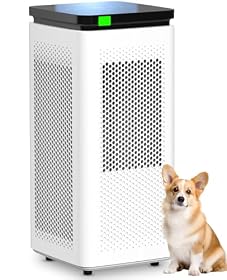
What Size Air Purifier Do You Need for a Living Room?
Measure the space, then compare its square footage with the purifier’s CADR-based room coverage. Adjust for high ceilings, open layouts, and how quickly you want the air cleaned.
For most living rooms, choose an air purifier whose smoke CADR is at least two-thirds of the room’s square footage when ceilings are about 8 feet high. For example, a 300-square-foot room calls for a smoke CADR of roughly 200 CFM or higher under this rule of thumb. Go larger for high ceilings, open floor plans, or faster air cleaning.
Measure the space first
Measure the living room’s length and width, then multiply them to get square footage. For an L-shaped room, measure each rectangular section and add the areas together.
The usual CADR rule assumes an 8-foot ceiling. If your ceiling is taller, account for the extra air volume. A practical adjustment is to multiply the room area by the ceiling height, then divide by 8. For example, a 300-square-foot room with 10-foot ceilings has about the same air volume as a 375-square-foot room with 8-foot ceilings.
Use CADR to compare purifier sizes
CADR, or clean air delivery rate, measures how quickly a purifier delivers filtered air. It is typically listed in cubic feet per minute (CFM), with separate ratings for smoke, dust, and pollen. For choosing a size, the smoke CADR is a useful conservative figure because it is usually the lowest of the three.
A common sizing guideline is a smoke CADR of at least two-thirds of the room’s square footage. This corresponds to roughly five air changes per hour in a room with an 8-foot ceiling. If you want fewer air changes, a unit may still be suitable, but it will clean the room more slowly. Compare CADR figures rather than relying on “large room” labels alone, and check how the manufacturer defines its recommended room size.
Living-room area with 8-foot ceilings
Approximate minimum smoke CADR
200 sq. ft.
135 CFM
300 sq. ft.
200 CFM
400 sq. ft.
270 CFM
500 sq. ft.
335 CFM
These are rounded estimates, not guarantees. Room shape, furniture, airflow, and the purifier’s operating speed can affect real-world cleaning.
Product prices and availability are accurate as of the date/time indicated and are subject to change. Any price and availability information displayed on Amazon.com at the time of purchase will apply to the purchase of this product.
Adjust for open layouts and ceiling height
If the living room opens into a dining area, kitchen, or hallway without doors, size the purifier for the combined area it needs to serve—not just the living-room footprint. If that total is beyond a single unit’s practical coverage, two purifiers placed in separate parts of the space may circulate air more effectively than one at the far end.
For ceilings higher than 8 feet, use the volume adjustment above or choose a model with a higher CADR. Tall ceilings, vaulted spaces, and open stairwells can make a room-size estimate based only on floor area misleading.
Product prices and availability are accurate as of the date/time indicated and are subject to change. Any price and availability information displayed on Amazon.com at the time of purchase will apply to the purchase of this product.
Check the speed you’ll actually use
A purifier’s room-coverage claim may assume it runs at its highest fan speed. That setting can be too loud for conversation or television. Look for a unit with enough CADR to meet your needs at a speed you can tolerate, and check whether its published coverage is tied to a particular air-change target.
Also consider the filter type and replacement-filter availability. A HEPA filter can capture airborne particles, while an activated-carbon filter can help reduce some odors and gases; a thin carbon layer may have limited capacity. Follow the manufacturer’s filter replacement guidance, since a loaded filter can reduce airflow.
Quick sizing checklist
Measure the living room and any connected open areas.
Adjust the area estimate for ceilings higher than 8 feet.
Compare the result with the purifier’s smoke CADR; use about two-thirds of the adjusted square footage as a starting point.
Check whether the advertised coverage assumes a high fan speed or a lower air-change rate.
Confirm that replacement filters are available and that the noise level is acceptable at the speed you expect to use.
When in doubt between two sizes, the larger unit gives you more headroom to run it at a quieter speed—provided its filters and operating costs fit your needs.
FAQ
What CADR do I need for a 300-square-foot living room?
With an 8-foot ceiling, a common rule of thumb is a smoke CADR of at least two-thirds of the floor area, or about 200 CFM for 300 square feet. Choose more capacity for higher ceilings, open adjoining spaces, or faster cleaning.
Is the room-size number on an air purifier enough to choose one?
Not by itself. Manufacturers may base room-size claims on different air-change rates. Compare CADR and check the coverage assumptions, including the fan speed used to reach the stated coverage.
Should I get one large purifier or two smaller ones for an open living area?
One unit may work if its CADR is adequate for the combined space and air can circulate through it. In a long or divided layout, two units placed in separate areas may distribute clean air more evenly.
Does a higher ceiling mean I need a larger air purifier?
Usually, yes. A taller ceiling increases the room’s air volume, so a purifier sized only by floor area may clean the space more slowly. Adjust the room area for ceiling height or select a higher-CADR unit.