AHAM CADR ratings tell you how quickly an air purifier removes three test particles: smoke, dust, and pollen. The ratings are reported in cubic feet per minute (CFM), and a higher number generally means faster particle removal. For most buying decisions, use the smoke CADR as the conservative benchmark for fine-particle problems, then confirm that the purifier's suggested room size fits your space.
Size & CADR · Mon Sep 07
AHAM CADR for Smoke Versus Dust Versus Pollen
AHAM CADR ratings show how quickly an air purifier removes smoke, dust, and pollen from room air. Here is how to compare the three numbers and choose the right one for your household problem.
What do you need help with?
Open an answer, or tell us what we should cover next.
Answered in this guide
Choose an air purifier that fits your room and main air problem
Match the purifier’s CADR to the pollutant you care about most, then check that its CADR and guidance fit your room. Smoke CADR usually matters most for fine particles, while dust or pollen CADR may better match other household concerns.
Compare smoke, dust, and pollen CADR ratings
Smoke CADR is generally the better comparison for wildfire, tobacco, cooking, and other fine particles. Dust CADR suits ordinary household dust, while pollen CADR is most relevant when airborne pollen is the main concern.
Understand what an AHAM CADR rating measures
CADR combines how well an air purifier removes test particles with how much air it moves. A higher rating means the unit can deliver clean air faster under the tested conditions.
Calculate whether a purifier is large enough for a room
Use CADR and AHAM room-size guidance to compare a purifier with the room it must serve. The guidance assumes standard ceiling height and repeated air changes, so room coverage should not be judged by marketing claims alone.
Avoid common mistakes when comparing air purifiers
Do not choose solely by the largest pollen number, compare room-size claims without checking their basis, ignore fan speed, or assume CADR measures odor removal. Match the rating and operating conditions to your actual need.
Need something else?
Request a topic and help us choose what to build next.
Choose one purifier or several for multiple rooms
Diagnose poor air quality despite a suitable CADR
Size a purifier for an open floor planRead this guide →
Requests help us prioritize the next guide. No email required.
One anonymous request per topic.
What AHAM CADR means
CADR stands for Clean Air Delivery Rate. It combines an air purifier's particle-removal performance with the amount of air the unit moves.
A purifier with a higher CADR can clean a given room faster than a purifier with a lower CADR, assuming similar operating conditions. CADR is more useful for sizing than airflow alone because it accounts for how effectively the machine removes the tested particles.
AHAM, the Association of Home Appliance Manufacturers, operates a certification program for air cleaners. A purifier with AHAM certification may list separate CADR results for:
- Smoke
- Dust
- Pollen
These are test categories, not measurements of every type of smoke, dust, or pollen found in a home.
Air purifiers with AHAM-verified CADR for smoke
 Air Purifiers for Home Bedroom Large Room Up to 1092 Ft² 1Hr AHAM VerifiedAirHub
$90.99 as of
View on Amazon DREO Air Purifier for Home, Up to 1176 ft², HEPA Sleep Mode, Air Purifiers for…DREO
$59.99 as of
View on Amazon AEOCKY 2300 ft² YearChange Air Purifiers with 240 CADR in Turbo ModeAEOCKY
$99.99 as of
View on Amazon
Product prices and availability are accurate as of the date/time indicated and are subject to change. Any price and availability information displayed on Amazon.com at the time of purchase will apply to the purchase of this product.
Smoke CADR
Smoke CADR is generally the most useful rating for fine particles, including many particles from tobacco smoke, wildfire smoke, cooking, and combustion.
Smoke particles used in testing are smaller than the particles represented by the dust and pollen categories. That makes smoke CADR a helpful conservative reference when your priority is fine airborne particulate matter.
Choose an air purifier with a strong smoke CADR if you are mainly concerned about:
- Wildfire smoke
- Tobacco smoke
- Fireplace or wood-burning particles
- Cooking smoke and fine grease particles
- Fine dust that remains suspended in the air
A high smoke CADR does not remove gases or odors by itself. For those problems, the purifier also needs an appropriate amount of activated carbon or another gas-adsorbing media. CADR ratings primarily describe particle removal.
Air purifiers for pollen and household dust
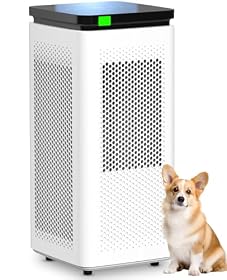 Hepa Air Purifiers for Home up to 3500 Ft², 235 CADR, 30dB Quiet OperationSIESEAN
$229.99 as of
View on Amazon Air Purifier for Home Large Room up to 3000Ft², HEPA Air Purifier with Washable Double-Sided…Dhyala
$129.99 as of
View on Amazon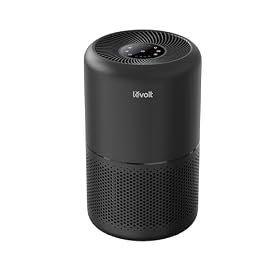 Levoit Air Purifier for Home Pets Hair Allergies in Bedroom Quiet PurifiersLevoit
$104.99 as of
View on Amazon
Product prices and availability are accurate as of the date/time indicated and are subject to change. Any price and availability information displayed on Amazon.com at the time of purchase will apply to the purchase of this product.
Dust CADR
Dust CADR measures performance against a larger test-particle category than smoke. It is relevant to ordinary household dust, some airborne debris, and particles stirred up by cleaning, foot traffic, or HVAC airflow.
Dust CADR is useful when your main concern is visible or settled household dust, but it should not be treated as a complete measure of how much dust will accumulate on furniture. An air purifier only captures dust that reaches its intake. Dust already settled on floors and surfaces still requires cleaning.
For a general-purpose purifier, compare the smoke and dust CADR rather than looking at the dust number alone. A unit with a strong smoke CADR is often the safer choice when you also want to address smaller airborne particles.
Pollen CADR
Pollen CADR measures removal of larger biological particles represented by the pollen test. It is especially relevant during seasonal allergy periods.
Pollen is relatively large compared with smoke particles, so a purifier may have a different pollen CADR from its smoke CADR. A strong pollen rating can be useful for bedrooms, living rooms, and other spaces where airborne pollen is a major concern.
However, pollen CADR does not prove that a purifier removes every allergen. Allergens can also be found in settled dust, fabrics, bedding, carpets, and pet debris. An air purifier works best as one part of an allergy-control plan that may also include cleaning, ventilation choices, and source reduction.
Which CADR should you use?
Use the rating that best matches your main problem, but do not ignore the other two numbers.
| Main concern | Rating to prioritize | Why |
|---|---|---|
| Wildfire or tobacco smoke | Smoke CADR | It is the most relevant of the three ratings for fine particles. |
| Everyday airborne dust | Dust CADR, then smoke CADR | Dust CADR matches the test category, while smoke CADR helps indicate fine-particle performance. |
| Seasonal pollen | Pollen CADR | It is the most directly relevant rating for larger airborne pollen particles. |
| Mixed household pollution | Smoke CADR and the room-size recommendation | Smoke CADR provides a useful conservative comparison for fine particles, while the room rating helps prevent undersizing. |
If two purifiers are otherwise similar, choose the one with the higher relevant CADR. If your needs are mixed, avoid choosing a unit based only on its highest single number. Check all three ratings and the manufacturer's recommended room size.
How to use CADR to size an air purifier
AHAM's room-size guidance is based on delivering multiple air changes per hour in a room with a standard ceiling height. As a simple comparison method, look for a smoke CADR of roughly two-thirds of the room's area in square feet.
For example, a 300-square-foot room would call for approximately 200 CFM of smoke CADR under that rule of thumb. This is a sizing guide, not a guarantee of identical results in every home.
You may want additional capacity when:
- Ceilings are higher than standard
- Doors are often open to adjoining rooms
- Smoke or particle levels are unusually high
- The purifier will usually run on a quiet, lower fan speed
- The room has poor air circulation
- You want faster cleanup after a pollution event
For an open floor plan, calculate the connected area that the purifier is expected to serve. One portable unit may not clean every connected space evenly, especially when walls, furniture, and closed doors interrupt airflow.
CADR versus the advertised room size
Room-size claims are not always presented in the same way. Some manufacturers use AHAM-verified room sizing, while others publish a larger maximum room area based on a lower air-change target or different assumptions.
When comparing models, prioritize information in this order:
- AHAM-verified room size, when available
- Smoke CADR in CFM
- The manufacturer's operating-speed assumptions
- Filter type and replacement-filter availability
- Noise, controls, and energy use at the speed you will actually use
A purifier advertised for a very large room may still be a poor choice if its useful CADR is low or if you plan to operate it only at its quietest setting.
Why the three CADR numbers can differ
Smoke, dust, and pollen are separate test categories with different particle characteristics. The filter and fan combination may remove each category at a different rate.
The results can also vary with:
- Fan speed used during measurement
- Filter loading and maintenance
- Airflow design
- Sealing around the filter
- Whether the rating is independently verified or manufacturer-reported
CADR does not directly tell you how quiet the purifier is, how much electricity it uses, or how long its filter will last. Those factors should be considered separately.
Common buying mistakes
Choosing the biggest pollen number
A high pollen CADR is not automatically the best choice for wildfire smoke or fine particles. Match the rating to the pollutant you care about most.
Comparing room-size claims without checking the basis
A room-size number without a stated air-change target can be difficult to compare with an AHAM-verified size. CADR provides a more consistent basis for comparison.
Ignoring fan speed
A purifier may produce its best CADR at a louder high setting. If you need quiet operation at night, select enough capacity that the unit can clean the room at a lower setting.
Treating CADR as odor removal
Particle CADR does not measure the removal of gases and odors. Look for a substantial activated-carbon filter when odors or gaseous pollutants are a major concern, and check whether replacement filters are readily available.
Assuming one purifier treats the whole home
A portable purifier is usually most effective in the room where it is operating. Closed doors, distant rooms, and ductwork limit how much cleaned air reaches other areas.
Bottom line
For smoke, prioritize smoke CADR. For ordinary airborne dust, compare dust CADR but also consider smoke CADR as an indicator of fine-particle performance. For seasonal pollen, pollen CADR is the most directly relevant rating. When the problem is mixed or uncertain, choose a purifier with a strong smoke CADR, an appropriate AHAM room-size rating, and enough capacity to run at a tolerable noise level.
If no CADR information is available, compare the manufacturer's room-size method carefully and be cautious about treating an unverified maximum room size as equivalent to an AHAM-verified rating.
FAQ
Is smoke CADR more important than pollen CADR?
It depends on the pollutant. Smoke CADR is more useful for fine particles such as wildfire smoke, while pollen CADR is more directly relevant to larger airborne pollen. For mixed concerns, smoke CADR is a practical conservative comparison.
Does a higher CADR remove odors better?
Not necessarily. CADR measures particle removal, not gas or odor removal. Odor performance depends mainly on the amount and design of activated carbon or other gas-adsorbing material.
What CADR do I need for a 300-square-foot room?
As a general AHAM-based sizing rule, look for about two-thirds of the room area in smoke CADR, or approximately 200 CFM for 300 square feet. Higher capacity may be appropriate for high pollution, high ceilings, open doors, or quieter operation.
Can one air purifier clean my entire home?
Usually, a portable purifier works best in the room where it is placed. Open doors and airflow may allow some cleaning beyond that room, but a single unit should not be assumed to clean every part of a multi-room home evenly.