Air changes per hour (ACH) tells you how quickly an air purifier can clean the air in a bedroom. To estimate ACH, multiply the purifier’s CADR by 60 and divide by the room’s volume in cubic feet. A bedroom purifier generally needs enough clean air delivery to provide several effective air changes per hour, not merely enough coverage for the room’s floor area.
Size & CADR · Mon Sep 07
Air Changes per Hour for a Bedroom Purifier
Air changes per hour, or ACH, estimates how many times an air purifier can filter the air in a room each hour. Use the room volume and the purifier’s CADR to determine whether a bedroom unit is appropriately sized.
What air changes per hour means
ACH is an estimate of the number of times a purifier could replace the room’s entire air volume with filtered air in one hour.
For example, an ACH of 4 means the purifier supplies filtered air equal to four times the room’s volume every hour. This does not mean every particle is removed after four passes. Air mixes unevenly, doors open, air leaks into the room, and particles may remain on surfaces or be generated continuously.
ACH is therefore a useful sizing estimate rather than a guarantee of pollutant removal.
Bedroom purifier sized by CADR
 Levoit Air Purifier for Home Pets Hair Allergens in Bedroom Quiet PurifiersLevoit
$84.99 as of
View on Amazon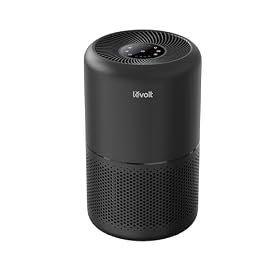 Levoit Air Purifier for Home Pets Hair Allergies in Bedroom Quiet PurifiersLevoit
$104.99 as of
View on Amazon Air Purifiers for Bedroom with 20dB Ultra-Quiet Sleep ModeJafanda Air
$35.00 as of
View on Amazon
Product prices and availability are accurate as of the date/time indicated and are subject to change. Any price and availability information displayed on Amazon.com at the time of purchase will apply to the purchase of this product.
How to calculate ACH for a bedroom purifier
Use this formula:
ACH = (CADR × 60) ÷ room volume
Calculate room volume as:
Room volume = length × width × ceiling height
Use the purifier’s smoke CADR, measured in cubic feet per minute, when available. Smoke CADR is commonly used as a practical indicator for fine airborne particles such as smoke and some small aerosols.
Example calculation
Suppose a bedroom is 12 feet long, 10 feet wide, and has an 8-foot ceiling:
12 × 10 × 8 = 960 cubic feet
A purifier with a smoke CADR of 200 cfm would provide approximately:
(200 × 60) ÷ 960 = 12.5 ACH
That calculation assumes the purifier is operating at the setting associated with the published CADR. A quieter night setting will usually deliver less airflow and therefore a lower ACH.
Particle filtration for bedroom use
- Levoit Air Purifier for Home Pets Hair Allergens in Bedroom Quiet PurifiersLevoit
$84.99 as of
View on Amazon  Purivortex Air Purifiers for Bedroom, Covers Up to 880 Sq Ft, PX500 BlackPurivortex
$29.99 as of
View on Amazon KNKA Air Purifiers for Home Bedroom Up to 1,695 Ft² in 1 Hr, APH4000, BlackKNKA
$119.98 as of
View on Amazon
Product prices and availability are accurate as of the date/time indicated and are subject to change. Any price and availability information displayed on Amazon.com at the time of purchase will apply to the purchase of this product.
What ACH should a bedroom purifier provide?
There is no single ACH number that fits every bedroom or health concern. A practical target is often around 4 to 5 effective air changes per hour for general particle reduction, with more airflow useful when the room has smoke, high outdoor pollution, pets, or a sensitive occupant.
The appropriate target depends on:
- The type and concentration of pollutants
- Whether the purifier runs continuously
- How often doors and windows are opened
- The room’s actual ceiling height
- How well the air mixes throughout the room
- Whether the purifier is operated quietly overnight
- The occupant’s sensitivity to dust, pollen, smoke, or other particles
For allergies or routine dust control, a purifier that can reach the target ACH on a comfortable continuous setting may be preferable to a smaller unit that must run at maximum speed. For wildfire smoke or other temporary pollution events, additional airflow may be helpful, but the purifier should be used according to the manufacturer’s instructions and local air-quality guidance.
Replacement filter for ongoing ACH
 Leemone Core Mini Replacement Filter for LEVOIT Air Purifier, 2 PackLeemone
$16.98 as of
View on Amazon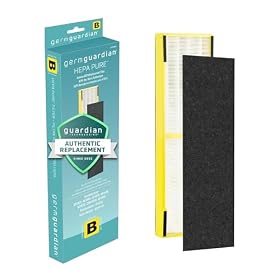 GermGuardian, Filter B HEPA Pure Genuine Air Purifier Filter, Removes 99.97% of Pollutants, Wildfire Smoke,…GermGuardian
$19.88 as of
View on Amazon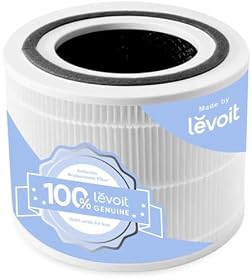 Levoit Core 300-P Air Purifier Replacement Filter, Genuine Air FiltersLevoit
$25.99 as of
View on Amazon
Product prices and availability are accurate as of the date/time indicated and are subject to change. Any price and availability information displayed on Amazon.com at the time of purchase will apply to the purchase of this product.
Convert a desired ACH into a CADR requirement
You can reverse the formula to determine the approximate CADR needed:
Required CADR = (room volume × target ACH) ÷ 60
For the 960-cubic-foot bedroom above, a target of 5 ACH would require approximately:
(960 × 5) ÷ 60 = 80 cfm
A purifier with a higher CADR can reach the target more quickly or maintain more airflow when operated below maximum speed. However, do not compare a purifier’s advertised room coverage with CADR alone unless the coverage rating states the testing or ACH assumption behind it.
Why advertised room size can be confusing
Air-purifier coverage claims may be based on different air-change assumptions. One manufacturer might list a large room at a relatively low ACH, while another might use a more demanding sizing standard. Two purifiers with the same advertised square-foot coverage may therefore provide different real-world airflow.
When comparing models, check:
- CADR, especially smoke CADR: Higher CADR generally means faster particle removal.
- The test or coverage standard: Look for the air-change assumption behind the room-size claim.
- Noise at the relevant speed: A purifier that is too loud for sleep may spend most of the night on a low setting.
- Filter availability: Confirm that replacement filters are available and that the filter fits the exact model.
- Energy use and controls: Continuous operation can matter more than occasional maximum-speed operation.
If a listing provides only a large square-foot number but no understandable CADR information, treat the coverage claim cautiously.
Adjust the calculation for ceiling height
Most simple room-size recommendations assume a standard ceiling height. A bedroom with a 10- or 12-foot ceiling contains substantially more air than a bedroom with the same floor area and an 8-foot ceiling.
For example, a 12-by-10-foot room has a volume of 960 cubic feet with an 8-foot ceiling, but 1,200 cubic feet with a 10-foot ceiling. The same purifier will produce a lower ACH in the taller room.
Use the actual ceiling height when the room has:
- Vaulted or cathedral ceilings
- An open loft area
- A partially open connection to a hallway or another room
- An unusually large volume above the normal ceiling line
Closing the bedroom door can also make the calculation more realistic. If the purifier is expected to clean an attached hallway or open living area, include that additional volume or use a larger purifier.
CADR is not the same as filter efficiency
A purifier can have an efficient particle filter but still clean a room slowly if its airflow is low. Conversely, strong airflow through a poorly suited filter may not provide the desired filtration.
For particle pollutants, consider both:
- Filter performance: A true HEPA filter is designed to capture a high percentage of small airborne particles under its applicable test conditions.
- Airflow or CADR: This indicates how much filtered air the unit delivers.
ACH combines these practical factors by estimating how much filtered air reaches the room. It is not a replacement for examining the filter design, but it helps prevent choosing a highly efficient filter with insufficient airflow for the space.
For odors and many gases, ACH alone is not enough. Look for an activated-carbon stage with a meaningful amount of carbon, and remember that carbon capacity and effectiveness vary considerably between purifier designs. HEPA filtration is primarily for particles, not general odor removal.
How bedroom use changes the calculation
Night mode
Night mode usually reduces fan speed to limit noise. Because CADR falls with fan speed, the purifier’s overnight ACH may be much lower than its maximum-rated ACH. If sleep is the priority, choose a unit with enough capacity that it can meet your desired airflow without operating at its loudest setting.
Closed versus open doors
A closed bedroom door limits the volume the purifier needs to serve. An open door allows air exchange with the hallway, but it also makes the room’s effective volume less predictable. A purifier placed inside the bedroom should not be assumed to clean an entire floor unless airflow can circulate effectively through that area.
Placement
Place the purifier where its intake and outlet are not blocked by walls, curtains, bedding, or furniture. Keep it on a stable surface or the floor as directed by the manufacturer. Leave the clearances specified in the manual so the unit can draw and discharge air properly.
Filter condition
A loaded pre-filter or clogged main filter can reduce airflow. Replace or clean filters on the schedule specified by the manufacturer, and inspect them sooner if the room contains pets, smoke, construction dust, or unusually high particle levels. A dirty filter can make the original ACH calculation no longer representative.
A simple bedroom sizing process
- Measure the bedroom’s length, width, and ceiling height.
- Multiply those measurements to find cubic feet.
- Choose a target ACH based on the pollutant and the occupant’s needs.
- Calculate the required CADR using room volume × target ACH ÷ 60.
- Compare that requirement with the purifier’s published CADR.
- Check the purifier’s noise level at the speed needed to reach the target.
- Allow for taller ceilings, open doors, poor placement, and reduced airflow from a dirty filter.
If the result falls between two purifier sizes, the larger unit usually provides more flexibility. It can be operated at a lower, quieter setting for ordinary use while retaining extra capacity for smoke or other short-term pollution.
When the calculated ACH does not match your results
If a bedroom still seems dusty or odors remain, first confirm that the purifier is actually running at the expected speed and that the intake and outlet are unobstructed. Then check the filter installation, pre-filter condition, and replacement interval.
Also consider whether the problem is airborne. A purifier will not remove dust that has already settled on bedding or furniture, and a particle filter may not solve an odor source, moisture problem, combustion issue, or mold problem. Address the source and follow appropriate safety guidance rather than relying on a purifier alone.
For persistent smoke, gas, combustion, or suspected mold concerns, leave the area if needed and consult qualified professionals or local health and safety guidance. Never use an air purifier as a substitute for a required carbon-monoxide alarm or for fixing a fuel-burning appliance or ventilation problem.
FAQ
What is a good ACH for a bedroom air purifier?
A practical general target is often about 4 to 5 effective air changes per hour, but the right level depends on the pollutant, room use, purifier noise, and occupant sensitivity. More airflow may be useful during smoke or high-pollution events.
How do I calculate ACH from CADR?
Multiply the purifier’s CADR in cubic feet per minute by 60, then divide by the room volume in cubic feet. Room volume is length multiplied by width multiplied by ceiling height.
Does a higher CADR always mean a better bedroom purifier?
A higher CADR generally means faster particle removal, but noise, filter quality, operating cost, controls, and replacement-filter availability also matter. A purifier that can provide the needed CADR quietly is often more useful than one that is only powerful at its loudest setting.
Does ACH apply to odors?
ACH mainly describes the delivery of filtered air and is most useful for airborne particles. Odor and gas removal depends heavily on the amount and design of activated carbon, as well as the source and concentration of the odor.
Should I calculate ACH using the purifier's maximum CADR?
Use the published CADR for the fan setting associated with that rating. If the purifier runs on a quieter setting overnight, its actual ACH will be lower than the maximum-speed calculation.