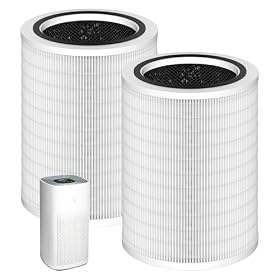
A 1,000 sq. ft. open living room needs more than a large coverage claim. Compare smoke CADR, account for ceiling height and layout, and consider multiple units for better air circulation.
What do you need help with?
Open an answer, or tell us what we should cover next.
Answered in this guide
Choose an air purifier that fits a 1,000 sq. ft. open room
Use the room’s total air volume and combined smoke CADR rather than the advertised coverage area. For a typical 8-foot ceiling, the checklist targets roughly 400–670 CFM, depending on the desired air-change rate.
Multiply room volume by the desired air changes per hour, then divide by 60. A 1,000-square-foot room with an 8-foot ceiling contains 8,000 cubic feet of air before applying the target rate.
Adjust purifier size for tall ceilings and open layouts
Use more CADR when ceilings are taller or the room connects to other open areas. A 12-foot ceiling holds about 50% more air than an 8-foot ceiling over the same floor area.
Choose a well-sealed HEPA or high-efficiency particle filter for dust, pollen, smoke, and fine particles. Use a washable pre-filter for hair and larger dust, while odor control needs suitable gas filtration.
Compare a single large unit with two smaller purifiers based on how evenly they can circulate air through an open room, along with noise, energy use, placement flexibility, and replacement-filter costs.
Request a topic and help us choose what to build next.
Replace and maintain the purifier’s filters
Test whether the purifier is cleaning the room well
Diagnose weak airflow, noise, or poor cleaning
Requests help us prioritize the next guide. No email required.
One anonymous request per topic.
Air purifier for a 1000 sq ft open living room
For a 1,000-square-foot open living room, choose an air purifier—or combination of purifiers—with enough CADR to circulate the room’s air several times per hour. Under standard assumptions of an 8-foot ceiling, look for roughly 650–670 CFM of smoke CADR for an aggressive cleaning target near 4.8 air changes per hour. A single unit may not distribute clean air evenly across a large, open layout, so two strategically placed units can be more effective and quieter than one oversized purifier.
Start with CADR, not the advertised room size
CADR, or clean air delivery rate, measures how quickly a purifier delivers filtered air. It is usually listed separately for smoke, dust, and pollen. For a large living area, the smoke CADR is a useful conservative comparison because smoke particles are small and harder to capture than larger dust particles.
Coverage claims can be difficult to compare because manufacturers may base them on different air-change targets. A purifier advertised for 1,000 square feet may be assuming only one or two air changes per hour, which may be adequate for general odor control but less useful for fast particle removal.
For a fair comparison, check:
Smoke CADR, preferably in cubic feet per minute
The air-change rate used for the coverage claim
Whether the rating assumes an 8-foot ceiling
Noise levels at the speed you expect to use
The cost and availability of replacement filters
How much CADR does a 1,000-square-foot room need?
The basic sizing formula is:
Required CADR = room volume × desired air changes per hour ÷ 60
With a 1,000-square-foot room and an 8-foot ceiling, the volume is 8,000 cubic feet. That gives these approximate targets:
Target air changes per hour
Approximate total CADR
2 ACH
267 CFM
3 ACH
400 CFM
4 ACH
533 CFM
4.8 ACH
640 CFM
The commonly cited AHAM sizing approach is close to two-thirds of the room’s square footage in smoke CADR, or about 667 CFM for a 1,000-square-foot room under standard conditions. Treat this as a useful comparison target rather than a guarantee of identical performance in every home.
If the purifier’s smoke CADR is listed in cubic meters per hour, divide by approximately 1.7 to convert it to CFM. If it is listed in cubic feet per minute, no conversion is needed.
Product prices and availability are accurate as of the date/time indicated and are subject to change. Any price and availability information displayed on Amazon.com at the time of purchase will apply to the purchase of this product.
Adjust for ceiling height and open layouts
A 1,000-square-foot room with a 12-foot ceiling contains 50% more air than the same floor area with an 8-foot ceiling. It therefore needs about 50% more CADR to achieve the same air-change rate.
Open-plan rooms also create practical limitations:
Long or narrow spaces: Air may not travel effectively from one end to the other.
Separate seating zones: Furniture, walls, and cabinets can block airflow.
Open stairwells: The purifier may be cleaning a larger air volume than the floor area suggests.
Connected kitchen areas: Cooking particles and odors can add a substantial filtration load.
Poor circulation: A purifier in one corner may have limited effect in a distant area.
For these layouts, two or more units are often easier to place effectively. For example, one purifier can serve the main seating area while another handles a connected dining or kitchen zone. Add their effective CADRs together when comparing them with a whole-room target, but remember that placement still matters.
Product prices and availability are accurate as of the date/time indicated and are subject to change. Any price and availability information displayed on Amazon.com at the time of purchase will apply to the purchase of this product.
Choose the right filtration for the problem
For dust, pollen, and fine particles
Look for a purifier with a properly sealed HEPA or high-efficiency particle filter. A washable mesh pre-filter is useful for catching hair and larger dust before it reaches the main filter, but it is not a substitute for the particle filter.
For smoke and wildfire particles
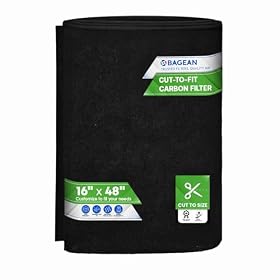
Prioritize high smoke CADR, a sealed filter compartment, and continuous operation at a tolerable speed. If the purifier uses a carbon layer, check how substantial the carbon stage is. A thin carbon sheet may help with light odors but can have limited capacity for heavy smoke or strong chemical smells.
During severe outdoor smoke, also close windows and doors as much as practical and follow local public-health guidance. An air purifier cannot remove gases or carbon monoxide reliably; never use it as a substitute for ventilation or a carbon-monoxide alarm where those are required.
For cooking and household odors
Particle filtration can capture some cooking aerosols, but odors require activated carbon. More carbon generally provides greater odor capacity, although manufacturers do not always publish the carbon quantity. Use the range hood or exhaust fan when cooking and run the purifier afterward.
For pets
A washable or replaceable pre-filter can reduce hair buildup, while the main particle filter helps with dander. Check the pre-filter regularly because clogged pet hair can reduce airflow and increase noise.
Product prices and availability are accurate as of the date/time indicated and are subject to change. Any price and availability information displayed on Amazon.com at the time of purchase will apply to the purchase of this product.
One large purifier or two smaller ones?
A single high-CADR purifier may be appropriate when the room is relatively open and you have a central placement with clear airflow around the unit. Two units can be preferable when:
The room has distinct seating or activity zones
The space is long, L-shaped, or partially divided
You want lower fan speeds and less noise from each unit
One location is near a major particle source, such as a kitchen connection
You want some filtration coverage if one unit is turned off
Compare the combined smoke CADR, not just the manufacturers’ combined square-foot claims. Also compare the total filter replacement cost and the electrical load of running both units continuously.
Product prices and availability are accurate as of the date/time indicated and are subject to change. Any price and availability information displayed on Amazon.com at the time of purchase will apply to the purchase of this product.
Placement matters in a large room
Place the purifier where air can enter and exit freely. Keep the intake and exhaust several inches away from walls, curtains, furniture, and other obstructions according to the manufacturer’s instructions.
Useful placement principles include:
Put one unit near the main occupied area rather than hidden in a corner.
Position a second unit near a separate zone or likely particle source.
Avoid placing the purifier directly behind a sofa or inside a cabinet.
Keep it away from splash-prone locations unless it is specifically designed for them.
Use a higher fan speed temporarily after cooking, cleaning, or opening windows, then reduce the speed for quieter continuous operation.
A ceiling fan or HVAC system can help mix the air, but it does not replace sufficient purifier CADR. Avoid directing a strong draft across the room if it carries dust toward occupants.
Noise, energy use, and filter cost
A purifier’s maximum CADR may be available only at its highest and loudest setting. For a large living room, check whether the unit can deliver useful airflow at the noise level you will actually tolerate during conversation, television, or sleep.
Before buying, confirm:
Noise information for more than just the lowest setting
Whether the purifier has an automatic mode and a manual speed control
Filter replacement interval guidance
The price and availability of compatible replacement filters
Whether the pre-filter can be vacuumed or washed
Whether the unit has an ionizer or ozone-generating feature you can disable
Replacement filters are a recurring operating cost. A purifier with a lower purchase price may cost more to operate if its filters are expensive, difficult to find, or replaced frequently.
Features that are useful—but secondary to CADR
A particle sensor and automatic mode can adjust fan speed as air quality changes, but sensor readings are not a substitute for proper sizing. An air-quality display can be helpful for observing trends, while app controls may be convenient for scheduling and remote operation.
Do not pay a premium for UV, ionization, or other add-on features unless you understand what they do and can disable them if desired. For most household particle problems, adequate airflow through an effective particle filter is the central performance factor.
A practical buying checklist
For a 1,000-square-foot open living room:
Use the room’s total volume, not floor area alone.
Target roughly 400–670 CFM of combined smoke CADR depending on whether you want about 3–4.8 air changes per hour.
Increase the target for ceilings higher than 8 feet.
Consider two units if the room is long, divided, or difficult to circulate.
Choose HEPA or high-efficiency particle filtration for dust, pollen, and smoke particles.
Choose meaningful activated carbon capacity when odor reduction is important.
Confirm noise, filter availability, and long-term filter cost.
Follow the manufacturer’s clearance, cleaning, and filter-replacement instructions.
If the purifier cannot keep up even at a reasonable speed, first check that the filter is installed correctly, the pre-filter is not clogged, and the intake and outlet are unobstructed. If the room remains difficult to cover, adding a second properly sized unit is usually more practical than expecting one small purifier to clean the entire space.
FAQ
Is one air purifier enough for a 1,000-square-foot open living room?
It can be, but only if its effective smoke CADR is high enough and air can circulate throughout the space. Two units may work better in long, L-shaped, divided, or high-ceiling rooms.
What CADR should I look for in a 1,000-square-foot room?
With an 8-foot ceiling, about 400 CFM provides roughly 3 air changes per hour, while about 640–670 CFM approaches a 4.8-ACH or AHAM-style target. Increase the target for higher ceilings.
Should I buy an air purifier rated for exactly 1,000 square feet?
Not necessarily. Compare smoke CADR and the air-change rate behind the coverage claim. A large coverage number based on a low air-change rate may not provide fast particle removal.
Are two air purifiers better than one large unit?
Two units can provide better distribution in an open or irregular room and may be quieter at their combined output. Compare their combined smoke CADR, placement options, noise, and total filter costs.
What type of filter is best for an open living room?
A HEPA or high-efficiency particle filter is appropriate for dust, pollen, pet dander, and smoke particles. Add activated carbon when odor or gaseous pollutants are a major concern.