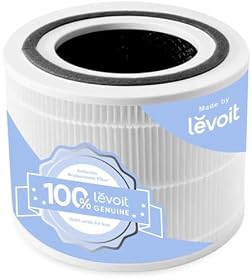
The best quiet HEPA air purifier for a bedroom should clean enough air for the room without forcing you to sleep through loud fan noise, bright indicators, or frequent maintenance. Compare noise ratings, CADR, sleep-mode behavior, filter design, and operating costs before buying.
A quiet HEPA air purifier for night use should provide enough airflow for your bedroom while keeping fan noise, display lights, and maintenance under control. Look for a true HEPA or equivalent high-efficiency particle filter, a published noise rating, a sleep mode that actually reduces fan speed and lighting, and a room-size rating based on an appropriate clean air delivery rate (CADR).
What to look for in a quiet bedroom air purifier
Noise rating and fan-speed control
Check the manufacturer’s noise specification, but pay attention to how it was measured. A low figure may apply only to the lowest fan setting, where air cleaning is also slower. If possible, compare noise levels across the settings you are likely to use overnight.
A purifier with several fan speeds gives you more flexibility than a simple low/high model. You can run it faster before bed to reduce airborne particles, then use a quieter setting while sleeping.
Some manufacturers list noise in decibels (dB). Because dB measurements can vary with distance and testing conditions, use the number as a comparison point rather than a guarantee of how the unit will sound in your room. Fan motor tone, airflow turbulence, and rattling can matter as much as the published rating.
A real sleep mode
Sleep mode commonly lowers the fan speed and dims or turns off the display. Before buying, check whether it:
Turns off all status lights or only dims them
Locks the fan to its quietest setting
Disables alerts or timers
Keeps automatic air-quality adjustments active
Allows the display and control lights to be turned off separately
A permanently bright air-quality ring or filter indicator can be distracting in a dark bedroom. If the product does not offer a fully dark mode, you may need to position it away from the bed or cover only the light source without blocking ventilation. Do not cover air inlets, outlets, or safety labels.
HEPA filtration
A HEPA filter is designed to capture fine airborne particles such as dust, pollen, and many particles associated with smoke. For general bedroom particle filtration, look for a product that clearly identifies its main particle filter as HEPA or states the applicable filtration standard. Be cautious with vague phrases such as “HEPA-like” unless the manufacturer provides enough information to explain the claim.
HEPA filtration does not remove every type of indoor pollutant. It is not a substitute for ventilation, moisture control, source removal, or professional treatment of mold. It also does not remove most gases and odors by itself.
Carbon filtration for odors
If bedroom odors are a major concern, look for a purifier with an activated carbon stage in addition to its particle filter. The amount and design of carbon can affect how useful it is for odors and certain gases. A thin carbon-coated filter may help with light odors, while stronger odor control generally requires more carbon and timely replacement.
Do not choose a purifier based on carbon filtration alone if your priority is dust, pollen, or fine particles. The HEPA filter and the purifier’s airflow are usually more important for those problems.
Match the purifier to the bedroom
Use room coverage as a starting point, not the only specification
Manufacturers may list a maximum room size, but coverage figures are not always calculated the same way. CADR is often more useful because it describes how quickly a purifier delivers cleaned air. A larger room or a room with higher particle loads generally needs more airflow to achieve the same cleaning rate.
For a bedroom, compare the purifier’s recommended room size and CADR with the actual room dimensions. If the room is open to a hallway or another area, a small bedroom-rated unit may not clean the entire connected space effectively.
A unit that is slightly more capable than the minimum can be useful because it may clean the room at a lower, quieter fan setting. However, a very large purifier may cost more, take up more floor space, and produce more noise at higher speeds.
Consider ceiling height and room layout
Coverage estimates often assume a standard ceiling height. A bedroom with high ceilings contains more air than a room with the same floor area and a standard ceiling. Open doors, large closets, and connected spaces also affect how much air the purifier must process.
Place the purifier where air can circulate freely. Keep the intake and exhaust clear of walls, bedding, curtains, and furniture, and follow the clearance distances in the manufacturer’s instructions.
Product prices and availability are accurate as of the date/time indicated and are subject to change. Any price and availability information displayed on Amazon.com at the time of purchase will apply to the purchase of this product.
Features that matter at night
Automatic mode and air-quality sensors
Automatic mode can adjust fan speed when the purifier detects changes in airborne particles. This may be convenient, but sensor behavior varies. Cooking smoke, sprays, dust, or outdoor air entering through a window can trigger a higher fan speed, which may be louder than expected during the night.
If uninterrupted quiet matters most, choose a model that lets you select a fixed low fan speed instead of relying entirely on automatic mode.
Timers and scheduling
A timer can run the purifier for a set period after you fall asleep. Scheduling is useful if you want higher airflow before bedtime and quieter operation overnight. Confirm whether the timer turns the unit off completely or changes it to another mode.
Controls and connectivity
Physical controls are useful if you do not want to use a phone at night. App control may add scheduling, filter reminders, and remote operation, but it should not be necessary for basic cleaning. If the purifier uses Wi-Fi, check whether core functions remain available when the network is unavailable.
Filter replacement access
A filter that is easy to remove and install is more likely to be maintained correctly. Check whether the filter compartment requires tools, whether the purifier indicates filter life, and whether replacement filters are readily available for the specific model.
Filter life depends on fan speed, indoor particle levels, pets, smoking, construction dust, and other conditions. Treat the manufacturer’s replacement interval as a guideline. Replace the filter when the indicator calls for it, airflow drops, odors return, or the filter is visibly loaded—while following the product instructions.
Product prices and availability are accurate as of the date/time indicated and are subject to change. Any price and availability information displayed on Amazon.com at the time of purchase will apply to the purchase of this product.
How to make a purifier quieter at night
Run the purifier on a higher setting before bedtime, then switch to sleep or low mode.
Place it on a stable, level surface to reduce vibration and rattling.
Keep it away from walls, curtains, and bedding that could obstruct airflow.
Check that the filter cover is fully closed and correctly seated.
Turn off unnecessary lights, alerts, and display indicators.
Clean the washable pre-filter if the instructions permit it.
Replace a clogged filter rather than forcing the purifier to run continuously at a higher setting.
Never remove the filter while operating the unit unless the manufacturer specifically allows that configuration. Unplug the purifier before opening the filter compartment or cleaning it, and keep liquids away from electrical components.
Product prices and availability are accurate as of the date/time indicated and are subject to change. Any price and availability information displayed on Amazon.com at the time of purchase will apply to the purchase of this product.
Quiet HEPA purifier buying checklist
Before choosing a model, verify:
The particle filter is clearly identified as HEPA or an equivalent high-efficiency filter.
The published CADR or room-coverage information suits your bedroom.
Noise information is provided for more than one fan setting, if available.
Sleep mode reduces fan speed and lets you control display lighting.
The unit has a fixed low-speed option if automatic mode becomes noisy.
Replacement filters are available and reasonably easy to install.
The filter includes a pre-filter for larger dust and hair.
Carbon filtration is included if odor control is important.
The purifier fits the available floor space without blocking its intake or outlet.
If the purifier remains unusually loud, rattles, or produces a burning smell, turn it off and unplug it. Check the filter installation, housing, and placement according to the manual. Do not open the motor or attempt electrical repairs yourself; contact the manufacturer or a qualified technician if the problem persists.
Product prices and availability are accurate as of the date/time indicated and are subject to change. Any price and availability information displayed on Amazon.com at the time of purchase will apply to the purchase of this product.
FAQ
What is the quietest setting on a HEPA air purifier?
The lowest fan speed or dedicated sleep mode is usually the quietest. Check whether sleep mode locks the fan to low speed and turns off the display, since some automatic modes may increase fan speed when they detect particles.
Is a HEPA air purifier safe to run while sleeping?
Many air purifiers are designed for continuous operation, but follow the manufacturer’s safety and placement instructions. Keep the unit on a stable, dry surface, maintain clear airflow, and stop using it if you notice overheating, a burning smell, damaged wiring, or unusual electrical behavior.
How quiet should a bedroom air purifier be?
There is no single noise level that suits everyone. Compare the manufacturer’s dB ratings at the settings you will use, and look for sleep mode, adjustable fan speeds, and independent display-light controls. Fan tone and vibration can affect perceived loudness as much as the published number.
Can a HEPA purifier remove bedroom odors?
HEPA filters target airborne particles rather than most gases and odors. For odor control, choose a purifier that also includes activated carbon, and address the odor source through cleaning, ventilation, moisture control, or other appropriate measures.