True HEPA filters meet a recognized particle-capture performance level, while HEPA-type is a broader marketing label that does not guarantee the same efficiency. If you are choosing an air purifier for allergies, dust, smoke, or fine particles, compare the filter claim, clean air delivery rate (CADR), room coverage, and replacement-filter availability—not just the word “HEPA.”
Filters & Dust · Mon Sep 07
True HEPA versus HEPA-type filters
True HEPA is a defined performance claim, while HEPA-type is a less-specific marketing term. Here is how the difference affects air-cleaning performance, replacement filters, noise, cost, and everyday use.
What is a True HEPA filter?
A True HEPA filter is a dense mechanical filter designed to capture at least 99.97% of particles at 0.3 microns under the commonly cited U.S. performance criterion. The 0.3-micron figure is often used because particles around that size can be among the most difficult for a fibrous filter to capture. HEPA filters can capture particles both smaller and larger than 0.3 microns through several filtration mechanisms.
True HEPA filters are intended to reduce airborne particles such as:
- Dust and household debris
- Pollen
- Mold spores
- Pet dander
- Many airborne particles associated with smoke
- Some bacteria and other biological particles carried in the air
A HEPA filter does not automatically remove gases, odors, or volatile organic compounds. Those require an activated-carbon or other gas-phase filter, and the amount and quality of carbon matter.
Replacement filters for a True HEPA purifier
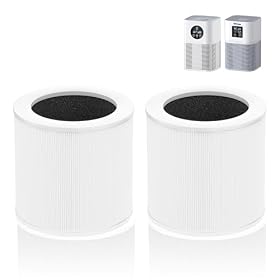 A1 Replacement Filter Compatible with VEWIOR Air Purifier A1, HQSC-50, HQKJ-80, AMEIFU AP01W, KOIOS HQKJ-50,…isingoione
$18.99 as of
View on Amazon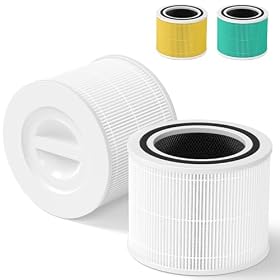 Core 300 Replacement Filter for LEVOIT Core 300, Core 300-P, Core 300S Vortex Air Air…Colorfullife
$25.64 as of
View on Amazon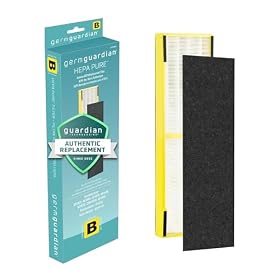 GermGuardian, Filter B HEPA Pure Genuine Air Purifier Filter, Removes 99.97% of Pollutants, Wildfire Smoke,…GermGuardian
$19.88 as of
View on Amazon
Product prices and availability are accurate as of the date/time indicated and are subject to change. Any price and availability information displayed on Amazon.com at the time of purchase will apply to the purchase of this product.
What is a HEPA-type filter?
“HEPA-type” generally means a filter is designed to provide some HEPA-like particle filtration, but the label does not establish one universal efficiency requirement. The actual performance can vary substantially between products.
A HEPA-type filter may be a reasonable choice for basic dust reduction, especially when it is part of an inexpensive purifier or replacement system. However, the label alone does not tell you:
- The percentage of particles captured
- The particle size used for the performance claim
- Whether the filter was independently certified
- How much air the purifier moves through the filter
- How well the complete purifier is sealed around the filter
If allergy, asthma, wildfire smoke, or fine-particle reduction is a major concern, a clearly specified True HEPA or equivalent high-efficiency filter is usually the safer choice.
Air purifier pre-filters
 4 Pack 211+ Replacement Washable Pre-Filters for Blueair Blue Pure 211+Cabiclean
$18.99 as of
View on Amazon 2 Pack KJ190L Filter Replacement For MOOKA KJ190 KJ190L KJ190H Air PurifieriSingo
$27.99 as of
View on Amazon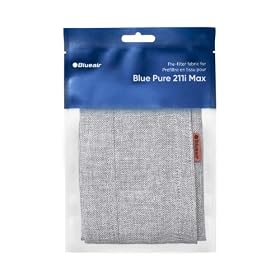 BLUEAIR Genuine Pre-Filter Blue Pure 211i Max Air Purifier, Washable Fabric, Fog GreyBLUEAIR
$12.99 as of
View on Amazon
Product prices and availability are accurate as of the date/time indicated and are subject to change. Any price and availability information displayed on Amazon.com at the time of purchase will apply to the purchase of this product.
True HEPA versus HEPA-type filters
| Feature | True HEPA | HEPA-type |
|---|---|---|
| Performance claim | Typically 99.97% capture at 0.3 microns under the stated test condition | No single universal performance threshold implied by the label |
| Consistency | More predictable when the claim is properly documented | Can vary widely by product |
| Fine-particle filtration | Generally the stronger choice | Depends on the specific filter |
| Allergy and smoke use | Usually preferred | May be adequate for light-duty particle reduction, but specifications should be checked |
| Price and airflow | May cost more or restrict airflow more | May be less expensive or easier to run, depending on design |
| Replacement compatibility | Must match the purifier model and filter design | Must also match the purifier; the label alone is not enough |
The most important practical difference is not simply the label. It is the combination of filter efficiency, airflow, sealing, and purifier CADR.
Carbon filters for odor control
 Bagean Cut to Fit Activated Carbon Filter Sheet 16” x 48” Carbon Air FilterBagean
$20.98 as of
View on Amazon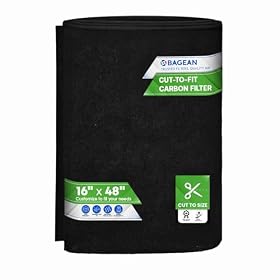 Bagean Cut to Fit Activated Carbon Filter Sheet 16” x 48” Carbon Air FilterBagean
$15.93 as of
View on Amazon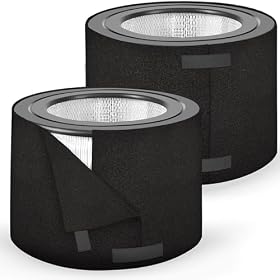 ID Air Systems Carbon Pre-Filter for Honeywell 50250 Air Purifier, 2 PackID Air Systems
$19.99 as of
View on Amazon
Product prices and availability are accurate as of the date/time indicated and are subject to change. Any price and availability information displayed on Amazon.com at the time of purchase will apply to the purchase of this product.
Why CADR matters as much as the filter label
A very efficient filter cannot clean a room effectively if the purifier moves too little air. CADR measures how quickly a purifier delivers filtered air for certain particle categories. A higher CADR generally means faster removal in the same room, assuming comparable conditions.
When comparing two purifiers, look for:
- A clearly stated filter efficiency or True HEPA claim
- A CADR appropriate for the room size
- A room-size recommendation based on a recognized testing method, when available
- A sealed filter compartment that limits air bypass
- Replacement filters that are available and correctly identified
A purifier with a HEPA-type filter and substantially higher airflow may remove particles faster than a very small purifier with a True HEPA filter. Conversely, high airflow does not make an unspecified filter equivalent to a properly documented HEPA filter. Consider both parts of the system.
Which filter is better for common household problems?
Allergies and pollen
Choose a purifier with a clearly specified True HEPA or equivalent high-efficiency particle filter. A pre-filter can extend the life of the main filter by catching larger hair and dust particles first.
Pet dander
True HEPA filtration can help reduce airborne pet-related particles. Keep in mind that much pet allergen settles on furniture, bedding, and floors, so filtration works best alongside regular cleaning.
Dust
Either filter type may reduce airborne dust, but a washable or replaceable pre-filter is particularly useful for larger particles. Do not assume a washable pre-filter replaces the main high-efficiency filter.
Wildfire smoke
Use a purifier with a well-specified high-efficiency particle filter and adequate CADR for the room. Smoke also contains gases and odors, so an activated-carbon stage can help. Thin carbon-coated sheets may provide less gas and odor capacity than a purifier containing a larger amount of carbon.
Cooking odors and chemical smells
Neither True HEPA nor HEPA-type filtration is designed primarily for gases. Look for an activated-carbon filter and follow the manufacturer’s replacement schedule. Ventilation and source control remain important.
Mold concerns
A purifier may capture some airborne mold spores, but it does not remove mold growth from walls, materials, or HVAC systems. Moisture control and professional remediation may be necessary when mold is present.
Does “HEPA-type” mean the filter is unsafe or useless?
No. It means the product label provides less information about standardized performance. Some HEPA-type filters may perform well for their intended use, while others may be much less efficient than True HEPA filters.
Before buying, check whether the manufacturer provides a particle-capture percentage, test conditions, CADR, and replacement-filter information. If those details are missing, treat the label as a general description rather than a measured performance guarantee.
Check the replacement filter before buying the purifier
Air purifier filters are consumable parts, so long-term ownership depends on more than the initial purchase. Confirm that:
- The replacement filter is made for the exact purifier model or series
- The filter includes the correct pre-filter and carbon layer, if required
- The manufacturer specifies a replacement interval or filter-life indicator
- The filter is readily available through a reliable source
- The replacement filter is not merely a thin insert being advertised as a complete HEPA filter
Do not force a different filter into the housing. Gaps around the filter can allow unfiltered air to bypass it, reducing the benefit of the purifier.
How to improve real-world filtration
Even a good filter performs poorly if the purifier is used incorrectly. For better results:
- Select a purifier with enough CADR for the room
- Run it at a higher setting when particles are elevated, if noise allows
- Keep doors and windows closed when outdoor smoke is the concern, unless ventilation is needed for safety
- Leave adequate clearance around the air intake and outlet
- Replace or clean the pre-filter as directed
- Replace the main filter when it is loaded, damaged, or the purifier indicates service is needed
- Do not wash a disposable HEPA filter unless the manufacturer specifically says it is washable
A dirty filter can restrict airflow and reduce the amount of air the purifier processes. A damaged or poorly fitted filter can allow bypass.
Bottom line
Choose True HEPA when you want a more clearly defined level of fine-particle filtration, particularly for allergies, smoke particles, and other airborne pollutants. A HEPA-type filter may be suitable for basic dust control, but its performance cannot be judged from the label alone.
For the best decision, compare the filter specification with CADR, room size, sealing, carbon-filter design, noise, and the ongoing cost and availability of replacement filters.
FAQ
Is True HEPA better than HEPA-type?
Usually, yes, when fine-particle filtration is important. True HEPA generally refers to a defined capture-performance level, while HEPA-type has no single universal efficiency requirement. The purifier’s CADR and sealing also affect real-world performance.
Does True HEPA remove odors?
Not by itself. True HEPA filters capture particles, while odors and many gases require an activated-carbon or other gas-phase filter. Carbon amount and design affect how useful it is.
Can a HEPA-type filter help with allergies?
It may reduce some airborne particles, but the result depends on its actual efficiency and the purifier’s airflow. For allergies, a clearly specified True HEPA or equivalent high-efficiency filter is generally easier to evaluate.
How often should a True HEPA filter be replaced?
Follow the purifier manufacturer’s instructions. Replacement timing depends on operating hours, particle levels, pre-filter maintenance, and the filter’s size. Replace it sooner if it is damaged or airflow drops noticeably.
Can I wash a True HEPA filter?
Usually not. Washing can damage the filter media and reduce its performance. Clean or replace it only according to the manufacturer’s instructions; many disposable HEPA filters should be replaced rather than washed.